Lore
Four stories this lake carries. One is a tradition still held by the people whose tradition it is. One has been told for two centuries with nothing found to confirm it. One has a documented history in which the most-quoted part is a fabrication. One is a town at the head of the lake that has written its monster into local law. Each says at the end what it rests on.
Odziozo, and the rock in the bay
Off Shelburne Point, a mile or so out from the Burlington shore, a bare rock stands out of the water with a light on it. Charts call it Rock Dunder. In Abenaki tradition it is Odziozo, and the lake is his. Before 1609 carries the same tradition beside the excavated record of the people who hold it.
Odziozo was made before he was finished, and he made himself. He had very short legs and long arms, and he shaped the country by hand — pushing up the mountains, dragging himself across the land because he could not walk, and opening the valleys and the rivers where he dragged. The lake was the last thing he made and the thing he was proudest of, and when it was done he put himself into the rock in the middle of it so that he could go on looking at it. He is there now. People left tobacco on the rock going past, and a satisfied Odziozo meant a quiet crossing.
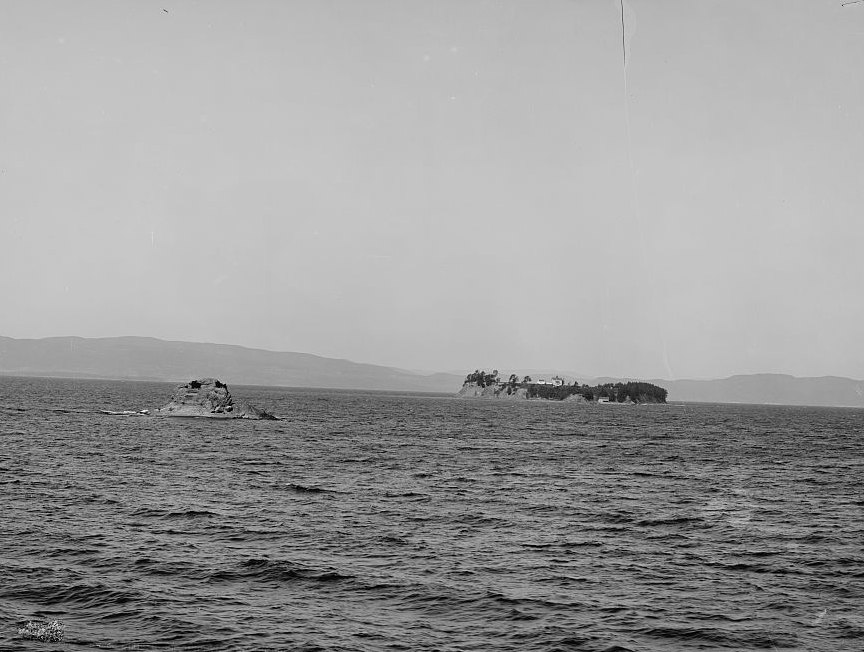
Abenaki tradition, recounted here from Vermont's state archaeologist Jess Robinson, who describes him as “not ‘the’ creator, but an ancient being that was known to have had very short legs and long arms”, who “made the hills and the mountains around here by forming them with his hands”, and who then “transform[ed] himself into Rock Dunder … so that he could admire his creation”. This is a living tradition and not a folk tale that has been finished with, which is why it is written here in the present tense.
Carleton's Prize
Between Stave Island and Providence Island there is a steep-sided rock about thirty feet out of the water with a level top. At a distance, in poor light, its profile is the profile of a hull.
On the night of 11 October 1776 Arnold's fleet slipped past the British line at Valcour in the dark and ran south. The story is that the next morning, in fog, Carleton's ships found a vessel lying in the channel ahead and fired into her for the better part of an hour before the fog lifted enough to show them they had been bombarding a rock. The rock has been called Carleton's Prize ever since — the prize he took.
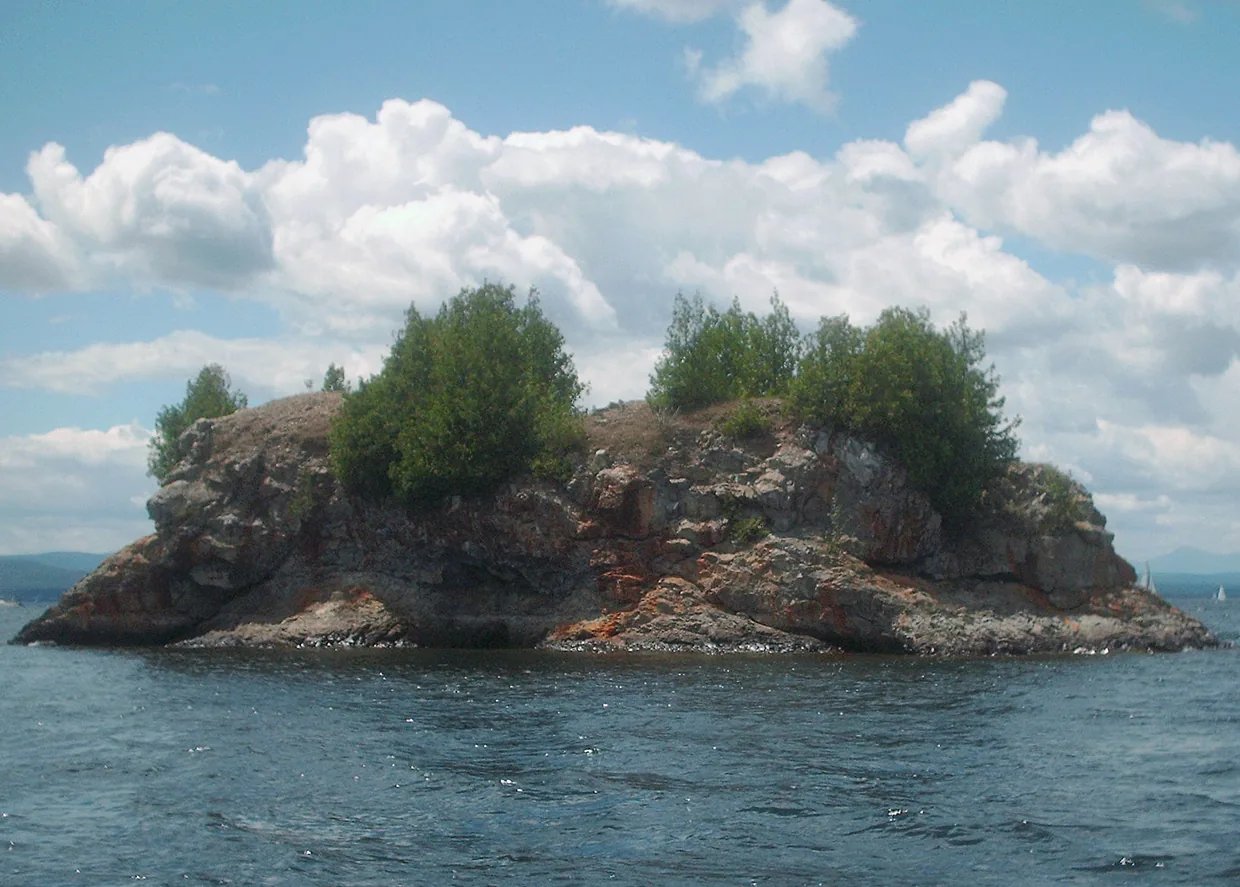

Told in local histories for two centuries. No contemporary British or American account has been found that confirms the bombardment. The rock is real, the name is real and on the chart, the battle is real and is on History; the hour of gunfire is the part nobody can produce a source for.
Champ
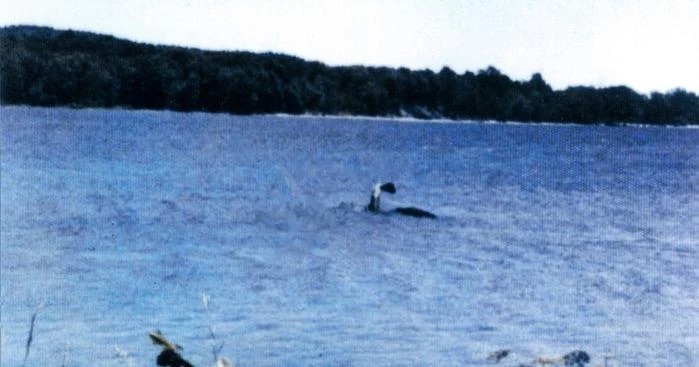
Something has been reported in this lake for a long time. What the reports come to, nearly every time, is the same three things: humps in the water, a wake, and then nothing. There is no specimen, no bone, and no photograph that settles it. The best known is Sandra Mansi's, taken in 1977 — and the negative was thrown away and she could not afterwards say where she had been standing, so there is nothing in it to measure.
The oldest account with a name on it is from July 1819. The Plattsburgh Republican of the 24th carried Captain Crum's report of the morning before, in Bulwagga Bay, off a scow: a black thing about two hundred yards from him, rearing more than fifteen feet out of the water, the head like a sea horse, a belt of red round the neck and a white star on the forehead. He put it at a hundred and eighty-seven feet long.
Three came in 1873. A railroad crew's sighting reached the New York Times, which reported the head of an enormous serpent with bright silvery scales. Sheriff Nathan H. Mooney of Clinton County put his at twenty-five to thirty-five feet in July. In August the steamship W. B. Eddy ran into it, and the tourists aboard reported she nearly went over.
In 1945 passengers aboard the Ticonderoga reported one. She is the boat built at Shelburne Harbor in 1906 that this site's own fleet carries, still in commission where that record's source stops in 1930, and she is the only vessel in these accounts a reader can still walk through: she is at the Shelburne Museum.
The protection the Plattsburgh marker refers to is three separate acts, none of them a statute. Port Henry declared its waters a safe haven for Champ in 1981. Vermont passed a House resolution in 1982. New York's Assembly and Senate each passed one in 1983.
These five accounts and the three resolutions are taken from the Lake Champlain Region visitors bureau's heritage page on Champ ↗, which names the Plattsburgh Republican for 1819 and the New York Times for 1873 without giving the issues. Nobody has been to those papers for this page. The same source separates Champlain from the story and identifies what he described as a garfish, which is the paragraph below.
The story is taken seriously as a story. Port Henry keeps a sighting board and a Champ Day on the first Saturday of August. In 2019 the William G. Pomeroy Foundation put a marker up on Cumberland Head Road in Plattsburgh, under a program called Legends & Lore, reading “Champy — legendary lake monster lives here. Over 300 sightings reported since 1819. Up to 200 feet long. NYS law protects this regional icon.” A marker in a folklore program is a record that the legend exists, which is exactly what it claims to be.
The part that is not true is the oldest-sounding part. Champ is routinely said to have been seen by Samuel de Champlain himself in 1609, described as a twenty-foot serpent, thick as a barrel, with a head like a horse. Champlain wrote nothing of the kind. The quotation first appears in the summer 1970 issue of Vermont Life, attributed to him, and no one has since found it in anything he wrote.
What he did write is on this site. On leaf 309 of his Voyages, at his page 216, he describes a fish the people of the country called chaousarou: eight or ten feet at the very largest, the ones he saw about five feet and as thick as his thigh, the head the size of his two fists, a snout two and a half feet long with a double row of teeth, a body shaped like a pike, scales a dagger would not go through, and silver-gray. The 1878 editor's own footnote on that page names it — the bony-scaled pike. It is a longnose gar, it is still in the lake, and anybody who has caught one knows how it got into a story.
The sightings are what they are: reports. The 1609 attribution is traced to Vermont Life, summer 1970. Champlain's own passage is quoted from the Prince Society edition this site carries, leaf 309, page 216, with the editor's note at 348.
Sasquatch at Whitehall
Whitehall stands at the head of the lake, where the water narrows into the canal, and it is one of the landings the steamboats called at. It is also where the Adirondack Bigfoot accounts are concentrated. What those reports come to is what the Champ reports come to: something seen, something measured after it had gone, and no specimen.
The case the town is known for is from August 1976, on Abair Road south of the village. Three young men, Martin Paddock, Paul Gosselin and Bart Kinney, reported a creature seven to eight feet tall and three to four hundred pounds, covered in short, coarse brown hair. Officer Brian Gosselin of the Whitehall police reported seeing it himself within days. Tracks nineteen inches long were found near the Poultney River bridge and cast in plaster. Those casts are the whole of the physical record: no photograph settles it, and no body was produced.

The protection is local law rather than state law. The Town of Whitehall passed an ordinance in 2004 declaring the town a sanctuary and making it an offense to hunt, harm or harass a sasquatch within the town limits, and nobody has been prosecuted under it. In June 2018 the village board voted four to nothing to name the sasquatch the village’s official animal, citing the four Bigfoot statues standing in Whitehall, the Bigfoot Half-Marathon and the Sasquatch festival, and set the last Saturday in September as Sasquatch Appreciation Day. The festival is held that day.
In 2023 the William G. Pomeroy Foundation put a marker up at 68 Skenesborough Drive, under the same Legends & Lore program as the Champ marker at Plattsburgh. It reads “Bigfoot sanctuary. For centuries, local stories tell of sightings of giant hairy beasts that walk upright and leave huge footprints. Local law protects them.”
The oldest-sounding part has the same shape here that it has with Champ. Samuel de Champlain is often credited with recording a giant hairy beast in this region, and the claim appears on the marker’s own page. The one monster in Champlain’s writing is the Gougou, which the Mi’kmaq described to him at Miscou Island in the Bay of Chaleur in 1603: a giant that carried people off and ate them, on the Gulf of St. Lawrence about five hundred miles from this lake, six years before he first saw it. Nothing he wrote about the Champlain valley describes a hairy upright creature.
The 1976 names, the tracks and the casts are taken from the Adirondack visitor bureaus’ own pages at Saranac Lake ↗ and Glens Falls ↗. The village vote is from the Times Union of June 2018. The marker’s wording, its address and its 2023 date are the Pomeroy Foundation’s own ↗. The Gougou is Champlain’s, in Des Sauvages of 1603; this page has not been to that text.